I have spent a large portion of my brief visits to Manila in the Greenbelt Mall in Makati -- a very, very upscale establishment which consists of five normal-medium sized malls stuck together with pathways. I thought this was fairly overwhelming, but had just begun to get the hang of it. Greenbelt 1 has the downscale hardware and book stores, Greenbelt 3 has the upscale restaurants, etc.
Then my boss asked me to make a trip to another mall to pick up a gift for a co-worker's wedding this weekend. The directions? Walk through Greenbelts 1-5. Then take the skybridge to the Landmark Mall across the street. Walk through Landmark to the Glorietta Mall on the other side. Walk through Glorietta Malls 1-5 to the SM Mall. Go to customer service desk at the opposite end of SM.
Oh. My. God. I am traumatized. I have never seen so many large malls with so many people. And there are four of them in a row. Or 12, depending on how you count.
On the other hand, I spent more than five minutes in a mall, and still felt like buying something, which I guess speaks fairly strongly to the quality of Filipino hyper-active consumerism, at least.
Showing posts with label stranger in a strange land. Show all posts
Showing posts with label stranger in a strange land. Show all posts
Saturday, December 13, 2008

Sunday, December 7, 2008
Muxes
Or, as just pointed out by me padre, maybe there is an equivalent for the below outside the Philippines.
Saturday, December 6, 2008
Bulua Miss Gay 2008
I approach the task of describing Friday evening with some considerable trepidation. The pictures I was able to take don't do it justice at all, so I'm feeling the need to compensate appropriately with words.
The brief story is that I spent the evening as a groupie for the 2nd runner up at the Bulua Miss Gay 2008 Pageant. It was as least as strange as it sounds; probably more so.
First, a little background. A small posse of gay boys lives upstairs in my dorm, one of whom is what the Filipinos call a girl-boy, or, as I learned last night, an uy-uy. JR prefers to be considered a woman, so I will refer to her that way from now on. From what I have observed and read, this really constitutes a separate gender in the Philippines. Cross-dressing is very prevalent here – it's not unusual for me to be at the mall and see a pack of young men wandering around in skirts and high heels. But beyond that, there seems to be a gender identity that resides somewhere at the intersection of male homosexuality, transgenderedness, and femininity that has no real Western equivalent.
Surprising as it may be in an overwhelmingly Catholic country with a vocal Muslim minority, the Philippines is in practice very tolerant of male homosexuality. There is certainly a bias that translates into discrimination – gay men tend to be associated strongly with the lower classes and customer service positions, and there is no question of them getting married. In practice, however, there is a large degree of good humored tolerance and even affectionate acceptance. I'm sure that part of this has to do with the sacrosanct nature of the Filipino family. As my friend Adrian (nee Richard) explained to me last night, if your son is gay you will just have to accept it – there is no question of cutting off ties or disowning him. Take as secondary evidence the fact that thousands of people showed up for this neighborhood gay pageant. Little kids, straight men, old women, siblings and co-workers of contestants, the local ruffians, the barangay captain and barangay policeman all crowded into the school gym and hooted and shrieked for a good three hours. There was no evidence that this was considered anything other than wholesome, mainstream Friday night entertainment.
 Let me try to take things chronologically. I departed from my dorm with Philip, Adrian, and Blaze (from L to R in picture). JR was already in Bulua getting prepared. We took a taxi to Bulua, an outlying barangay in Cagayan de Oro. It is important to note that the gay boys are unusually kind to me, and that their English is generally superior to everyone I've met except the Lims. They were very intrigued by the fact that I wanted to attend the pageant. Did I know any gays in the US? Had I ever been to a gay pageant? Do gays in the US look the same as in the Philippines?
We arrived in Bulua at 6:45. The pageant was scheduled to start at 7. There were literally 20 people there. I was already starting to feel sorry for the competitors – clearly this was some sort of hokey local pageant for outcast gays, and no one wanted to watch. We took a seat in the bleachers. It was hot. We were restless. Blaze joked that the pageant would probably start around 9pm – on Filipino time. Adrian suggested that we go backstage and visit JR. Although we could see 20 contestant numbers laid out on the judges' table, there turned out to only be about four contestants actually present backstage. I wondered about this. We visited with JR, who was surrounded by an older woman and a young man and woman who were trying to do her hair. She was very nervous – worrying about her hair, about her introductory speech, and about her registration form. A few little kids were hanging around and pasting shiny stuff onto big palm-woven discs that looked liked shields, but not much else was happening, so we decided to go to Jollibee for a snack, just across the road.
After some chicken and rice, we came back to the gym. 8pm. Still no one in the audience. We went backstage again, and this time there were at least 10 competitors there. Adrian explained to me that they don't like to get there early because gays are bitches and will 'borrow' o ne another's beauty supplies and not return them. Interesting. By this time, a few of the more professional candidates had arrived, and things were buzzing backstage with their groupies and little girls watching them dress. We stuck around for a while. The contestants seemed completely nonchalant about having an audience while preparing. A rather busty contestant stood up in the middle of the room and stripped while her helpers prepared her evening gown, and everyone watched. I will say that she did not resemble anything we would expect at a gay men's pageant in the US and leave it at that. I flirted with some little girls, who wanted to know how old I am and whether I have a sister. It was 8:30 and still hot and still no sign of things getting started, so we went back downstairs and took a seat on the bleachers again. Things started to fill up – maybe a few hundred people.
By 9:30, the gym was packed, with hundreds of people in the bleachers and thousands standing on the basketball court. Kids swarmed behind the judges' table, while an elderly barangay policeman with a whistle on a string of rosary beads pretended to be angry and swatted at them to move back; they all responded by grinning, mano po-ing, and continuing to run amuck. Guys selling peanuts and little bags of flavored popcorn were making the rounds. I was squished in between Adrian and Philip – Blaze had gone upstairs to provide moral support to JR who had texted us to say that her hair dresser and registration fee had disappeared and she was having a major case of stage fright. Philip, who is too shy to talk to me because he thinks his English is bad, was variously leaning on me, resting his arm on my lap, and scooting me further over into JR. Filipinos are not particular about personal space. I will note here that straight men in the Philippines wander around with their arms around one another and lean and hold hands, etc without anyone considering it 'gay'.
Finally, around 9:35 the announcer said the competition would be starting! In ten minutes. I realized that Blaze was not joking about Filipino time. More squishing. The gym was getting hot and sticky. There were thousands of people, some of whom were smoking and making the atmosphere even tighter than it would otherwise have been. I felt sorry for the people sitting in the bottom row of the bleachers, who surely wouldn't be able to see over the standing crowd. At 9:45 the pageant actually started. For five minutes, the announcer recites an endless list of names and titles, as is wont to happen in the Philippines. They thank everyone who has had anything to do with anything and recite all of their titles and ties: we thank Honorable Barangay Captain So-and-so; we thank the Bulua Barangay Council including the Honorable blah and the Honorable blah; we thank the Bulua Youth Council; we thank the wife of Honorable Mayor So-and-so. And on. And on. At this point I also stopped feeling sorry for the people in the bottom row of the bleachers – their obvious solution was just to stand up and block my view instead.
 Then, the candidates were called out on stage for the first time, in their bathing suits. This terrible picture is the best I could do from my far-off seat in the poorly lighted gym, but I hope it will suffice as evidence that these candidates did not look like boys. In fact, they looked like they could probably take home prizes at prestigious women's beauty pageants in the US. Some had breast implants, others were wearing silicon breasts (as I found out later). None of them displayed any evidence of being male, despite wearing itsy-bitsy, teeny-weeny bikinis. Each candidate was called up to a microphone to introduce herself. Each recited a short motto ("Don't judge a book by its cover." "When God closes a door, somewhere he opens a window." "Beauty is as beauty does.") and recited her qualifications. JR, as I knew, is a registered nurse and was valedictorian at her high school. She had some stage name I didn't entirely catch – Christina Concepcion Ramos or something like that. The candidates came from as far away as Zamboanga and Butuan. Some were nervous, some were flirtatious. Most of the speeches were partly in English, partly in Bisaya. (It is an odd feature of Filipino public events that the announcing is likely to be in English, even when the entire audience is Bisayan.) As one contestant put it: "I was the star of Gingoog. Now I stand before you, sexier, bombastic, and more arousing!"
The bathing suit competition was incredible. Most of the women must take hormone pills, and many looked like they'd had breast or facial plastic surgery. There was a large contingent that was tall and unbelievably slender, and a smaller group that looked more like most actual Filipinas – petite, and pleasantly round. Almost all seemed rather experienced at sashaying around suggestively in heels. They all posed and twirled like runway models. As each came forward, the announcer listed her 'measurements', which – I'm pretty sure – were complete bullshit. The tall, slender one s definitely did not have 36" chests, and the small, plump ones definitely did not have 24" waists. All this time, va-va-voom music is blasting, the audience is screaming and hooting, and a small colored spotlight is projecting swirly shapes onto the stage and audience. Next, there was a break for judging, during which we were treated to that now globally mandatory intermission special: the troop of early adolescent breakdancing boys. Next, the evening gown competition. The gowns were all quite original and flamboyant – none of the junior prom look. I couldn't get any good pictures, but for a taste, see JR in her gown with groupies after the awards were handed out.
The question and answer round was surprisingly substantial, at least for some candidates. Most were asked to explain their mottos from their introductions; a few were asked to explain their stated career goals. JR was asked "As a homosexual, what is your greatest aspiration in life?" My instant reaction, of course, was as a homosexual? Why should this affect your greatest aspirations, blah blah blah. I think, however, that this was the cue for JR to be able to say something a little more topical. Her answer was long, and I only understood part of it, but she ended with, "We did not ask to be made this way, but we homosexuals are also part of God's creation. My aspiration is to be respected in a peaceful and loving Filipino society."
After all 20 candidates did their question and answer session, the first elimination round commenced. I accept that I am lacking in context for the standard of beauty in this competition, but it seemed clear that the goal was to look as much like a glamorous woman as possible. There did seem to be some tension between the candidates who were using surgery and hormones to become more physically female, and those who were dressing up their given bodies to look more female. Either way, the choice of the five finalists was truly bizarre. The first chosen was the most manly-looking of the 20 – the only one who would have fit in a standard American drag context. Her clothes did not flatter her, and she seemed nervous and unpracticed throughout the competition. The second choice was the short, chubby contestand – the one with huge breast implants who had stripped backstage. The third was one of the tall slender girls, who had won the 'best gown' award. She was beautiful, but maybe not the most beautiful of the tall girls. The fourth was JR, who is delicate and pretty, but clearly does not have surgery or hormone treatments. The fifth was another one of the petite girls who looked cute but had a fairly unflattering gown. Each of the top five participated in another question and answer session, this one significantly more hard-hitting. The first girl was asked who should take responsibility for the financial crisis in the Philippines – the president, or the people? JR was asked who she would support in the next presidential election and why. Making the Philippines into a 'progressive nation' and having the people take responsibility for development were common themes.
The candidates were allowed to choose which judge would ask them a question. The tall contestant was the only one who chose judge #1 – Miss Gay Bulua 2006. Adrian whispered to me that they were friends. Ah. After that, I was able to correctly predict the order of the awards among the five. We had two finalists who were probably the least attractive (by the standards of the competition), two who were cute but middle-tier, and only one who was in the top-tier but who would not have stood out if compared to the others who looked like her. And that last was friends with one of the judges. The manly contestant was fourth runner up. The chubby contestant was third runner up. JR was second runner up. The short contestant in the bad dress was first runner up. And, surprise! The tall contestant was the winner.
 I don't want to be disloyal to JR. She looked very, very pretty, and I appreciated that she was someone who stood out as not having starved or carved up her body. She is also clearly very intelligent and gave by far the most interesting answers in the Q&A rounds. But, I suspect that she and the other three runners up were placed in the top five to provide a more convincing contrast with the winner. In any event, JR seemed quite happy, and her much-expanded groupie bunch (her nurse co-workers showed up halfway through the competition) was ecstatic.
I do n't think that I've fully processed this happening yet. It's clear that this could not have happened anywhere other than the Philippines. I had strongly considered just going to the mall to have some dinner and write a blog post on Friday night instead of going out with the boys. Fortunately, sometimes my better instincts overwhelm my day-to-day anti-social idiocy.
Sunday, November 30, 2008
Old jeepneys, new tricks
I finally noticed a much more subtle and likely more effective jeepney trick than those previously mentioned. The driver pays some of the young guys who skulk around the mall entrance to sit in the back and make it look like there are more passengers and the jeepney will leave sooner. When real passengers start to get on, they hop off. It took me a long time to figure out what was going on. Even if you're Filipino and used to it, it would be pretty hard to tell if they were legit passengers or not until it was too late. Very sneaky.
Saturday, November 29, 2008
Things I wish I had known: Part 4
Communication edition
Speak really slowly – like you're giving a speech. You may feel like you’re being condescending, but in general it will help people understand you. Also, much like giving a speech, you actually don’t sound nearly as slow to your audience as you do to yourself.
Be literal and specific. Don't use generalities or expect people to figure out what you need from a description of your purpose. For instance, as I have discovered the hard way, “I need tables A, B, and C from your transactions records database for January 2008 through the present” works much, much better than “I am trying to find out how much the average client saved over the last year” or even “I need to see client details and transactions history for the last year”.
Try to use local honorifics and figures of speech. It has taken me a long time to get comfortable calling people “Ma’am So-and-So” and even longer to get my mouth around “Sir So-and-So”. I know that this doesn’t sound strange to people here, and in fact, it is probably disrespectful for me to refer to an older woman without calling her ma’am. Nonetheless, it took me quite a while to get used to it.
Watch out for local patterns of conversation that indicate or cause misunderstanding. For instance, in the Philippines people will answer negatively phrased questions literally – unlike standard practice in native English-speaking countries (eg. Me: “This doesn't have shrimp in it, does it?” Waiter: “No” = “No, the statement that it does not have shrimp is incorrect” = “Yes, it DOES have shrimp in it” = recipe for death). People are also highly likely to say “yes” when they have no idea what you’re talking about or think you are being an idiotic American but are too polite to say so. It took me a while to figure out that a non-committal but affirmative sounding “o-o” (yes) while refusing to make eye contact means, “uh, sure, whatever you just said”.
Speak really slowly – like you're giving a speech. You may feel like you’re being condescending, but in general it will help people understand you. Also, much like giving a speech, you actually don’t sound nearly as slow to your audience as you do to yourself.
Be literal and specific. Don't use generalities or expect people to figure out what you need from a description of your purpose. For instance, as I have discovered the hard way, “I need tables A, B, and C from your transactions records database for January 2008 through the present” works much, much better than “I am trying to find out how much the average client saved over the last year” or even “I need to see client details and transactions history for the last year”.
Try to use local honorifics and figures of speech. It has taken me a long time to get comfortable calling people “Ma’am So-and-So” and even longer to get my mouth around “Sir So-and-So”. I know that this doesn’t sound strange to people here, and in fact, it is probably disrespectful for me to refer to an older woman without calling her ma’am. Nonetheless, it took me quite a while to get used to it.
Watch out for local patterns of conversation that indicate or cause misunderstanding. For instance, in the Philippines people will answer negatively phrased questions literally – unlike standard practice in native English-speaking countries (eg. Me: “This doesn't have shrimp in it, does it?” Waiter: “No” = “No, the statement that it does not have shrimp is incorrect” = “Yes, it DOES have shrimp in it” = recipe for death). People are also highly likely to say “yes” when they have no idea what you’re talking about or think you are being an idiotic American but are too polite to say so. It took me a while to figure out that a non-committal but affirmative sounding “o-o” (yes) while refusing to make eye contact means, “uh, sure, whatever you just said”.
Wednesday, November 26, 2008
Things I wish I had known: Part 3
Transportation edition
Ask multiple people for directions. If people don’t know, they will make something up just have something to say.
Take public transport, when possible. It's probably about 1/10th the price of a private car or taxi. On the other hand, when you’re tired, stressed, worried about getting lost, or worried about being somewhere dangerous, remember that even the private car is probably costing you a tenth of what it would in a developed country.
Clarify that you are traveling on the meter as soon as you get into a taxi (or before you get into it). If the driver tries to argue with you and keep driving, threaten to get out and find another taxi (and do it, if they won’t listen). Don’t be tempted by offers of special off-the-meter deals. Think about it – what incentive would they have to offer you a deal that would cost you less than the meter? They will never offer you something less than the meter rate.
Keep your eye on the meter in taxis, even after it is turned on. Plenty of taxi drivers will add miles when you’re not looking.
Keep valuables in the seat with you rather than in the trunk so that the driver is not tempted to drive off as you get out. Also, don’t pay until after you have removed your belongings from the taxi, including the trunk.
Have all of your travel documents with you when you cross international borders. Some countries will want to see your departing ticket before issuing a tourist visa. Others will want to see proof of yellow fever immunization (mostly in Africa). Most importantly, do not be like me and leave your passport on the other side of the country when you are trying to get home.
Ask multiple people for directions. If people don’t know, they will make something up just have something to say.
Take public transport, when possible. It's probably about 1/10th the price of a private car or taxi. On the other hand, when you’re tired, stressed, worried about getting lost, or worried about being somewhere dangerous, remember that even the private car is probably costing you a tenth of what it would in a developed country.
Clarify that you are traveling on the meter as soon as you get into a taxi (or before you get into it). If the driver tries to argue with you and keep driving, threaten to get out and find another taxi (and do it, if they won’t listen). Don’t be tempted by offers of special off-the-meter deals. Think about it – what incentive would they have to offer you a deal that would cost you less than the meter? They will never offer you something less than the meter rate.
Keep your eye on the meter in taxis, even after it is turned on. Plenty of taxi drivers will add miles when you’re not looking.
Keep valuables in the seat with you rather than in the trunk so that the driver is not tempted to drive off as you get out. Also, don’t pay until after you have removed your belongings from the taxi, including the trunk.
Have all of your travel documents with you when you cross international borders. Some countries will want to see your departing ticket before issuing a tourist visa. Others will want to see proof of yellow fever immunization (mostly in Africa). Most importantly, do not be like me and leave your passport on the other side of the country when you are trying to get home.
Sunday, November 23, 2008
Things I wish I had known: Part 2
Avoiding harassment edition
Learn to say no in the appropriate tone of voice. Usually I try firm but gentle first, because especially if people are just trying to sell you something, there’s no reason to get offended or offend them. After that, sometimes angry and confident works best, sometimes laughing at them. Seriously, I’ve found that especially with men, laughing and rolling my eyes at them while saying no often works better than anything else. (Not friendly giggle-giggle laughing. Like, I-can’t-believe-how-ridiculous-you-are, you-are-so-beneath-me-that-I’m-not-taking-your-harassment-seriously laughing.)
If you don’t want attention, avoid eye contact and don’t smile. This sounds terrible, and it’s certainly not a way to get to know your neighbors and meet the locals. But if you’re in a particular place and time where you need to be left alone, don’t think you can get away with being polite and not attracting unwelcome attention. I’ve definitely noticed that men who are watching me but not saying anything will inevitably start in on their “Hey American girl” routine the second I look at them.
Remember that you will never see these people again. Actually, this is always my rule for overcoming embarrassment, but it works particularly well in countries where I have no clue what I’m doing and feel like I’m constantly making a fool of myself. This rule helps me err on the side of just doing it rather than freaking out about potential embarrassment, and also to let go of something afterward and not replay it in my head over and over again once I’ve already screwed up. So what if I mispronounced things, or over paid, or whatever? Really – I will never see those people in Bohol again. Ever.
Again, any additions? Especially women?
Learn to say no in the appropriate tone of voice. Usually I try firm but gentle first, because especially if people are just trying to sell you something, there’s no reason to get offended or offend them. After that, sometimes angry and confident works best, sometimes laughing at them. Seriously, I’ve found that especially with men, laughing and rolling my eyes at them while saying no often works better than anything else. (Not friendly giggle-giggle laughing. Like, I-can’t-believe-how-ridiculous-you-are, you-are-so-beneath-me-that-I’m-not-taking-your-harassment-seriously laughing.)
If you don’t want attention, avoid eye contact and don’t smile. This sounds terrible, and it’s certainly not a way to get to know your neighbors and meet the locals. But if you’re in a particular place and time where you need to be left alone, don’t think you can get away with being polite and not attracting unwelcome attention. I’ve definitely noticed that men who are watching me but not saying anything will inevitably start in on their “Hey American girl” routine the second I look at them.
Remember that you will never see these people again. Actually, this is always my rule for overcoming embarrassment, but it works particularly well in countries where I have no clue what I’m doing and feel like I’m constantly making a fool of myself. This rule helps me err on the side of just doing it rather than freaking out about potential embarrassment, and also to let go of something afterward and not replay it in my head over and over again once I’ve already screwed up. So what if I mispronounced things, or over paid, or whatever? Really – I will never see those people in Bohol again. Ever.
Again, any additions? Especially women?
Friday, November 21, 2008
Things I wish I had known: Part 1
Things I was glad I brought or wish someone had told me to bring before I started traveling in developing countries:
Hand sanitizer – There won’t be soap, and sometimes not even water.
Toilet paper – Really. Especially in Asian countries, in my experience. You don't have to cart this with you from the US, but definitely buy some and carry it with you when you travel in-country.
A bandanna or large, sturdy handkerchief – Will double to wipe away sweat so you don’t look and feel so nasty, and to cover your mouth while you sit in smoggy traffic in big cities.
A very small umbrella – I haven’t taken my own advice on this one, but the point is that rain in the tropics is different than in a lot of the US – if you are out in it uncovered for even a minute you will be drenched and it might take you a week to dry out again.
Ciprofloxacin – Easily available broad-spectrum anti-biotic, which fixes everything.
Non-rot-able flip-flops – For beaches, showers, and keeping your feet cool. But make sure they’re not leather or fabric that will rot if they sit around wet in your bag overnight.
A big sarong – Serves as pretty much everything: towel when your hotel doesn’t have one, beach cover up, blanket on long bus rides where the AC is up too high, something to wear in your hotel when there is no AC and it’s too unbearably hot to wear clothing, pillow, bag to wrap your laundry in…
A scrunch-able fleece or sweatshirt – Paradoxically, stores and vehicles in tropical countries seem to have no middle ground between unbearable heat and uncomfortably strong AC. You will want something warm surprisingly often.
A small, zip-able change purse – You don’t want to carry a wallet or loose change in your pocket because it will be stolen, but you’ll need regular access to small change for buying food and paying for transportation.
A very tough medium-sized backpack – It makes no sense to carry a wheeled suitcase for short trips, because there are no sidewalks or escalators, so you’ll end up hefting it around anyway. A pack that is large enough for weekend excursions and small enough to carry for a long time without killing your back is ideal. (Thanks, Barbara!)
I’m compiling a list for my friends and new IPA hires. Anyone have anything to add? (I’m looking at you, people I know have traveled in Thailand/live in Beirut.)
Hand sanitizer – There won’t be soap, and sometimes not even water.
Toilet paper – Really. Especially in Asian countries, in my experience. You don't have to cart this with you from the US, but definitely buy some and carry it with you when you travel in-country.
A bandanna or large, sturdy handkerchief – Will double to wipe away sweat so you don’t look and feel so nasty, and to cover your mouth while you sit in smoggy traffic in big cities.
A very small umbrella – I haven’t taken my own advice on this one, but the point is that rain in the tropics is different than in a lot of the US – if you are out in it uncovered for even a minute you will be drenched and it might take you a week to dry out again.
Ciprofloxacin – Easily available broad-spectrum anti-biotic, which fixes everything.
Non-rot-able flip-flops – For beaches, showers, and keeping your feet cool. But make sure they’re not leather or fabric that will rot if they sit around wet in your bag overnight.
A big sarong – Serves as pretty much everything: towel when your hotel doesn’t have one, beach cover up, blanket on long bus rides where the AC is up too high, something to wear in your hotel when there is no AC and it’s too unbearably hot to wear clothing, pillow, bag to wrap your laundry in…
A scrunch-able fleece or sweatshirt – Paradoxically, stores and vehicles in tropical countries seem to have no middle ground between unbearable heat and uncomfortably strong AC. You will want something warm surprisingly often.
A small, zip-able change purse – You don’t want to carry a wallet or loose change in your pocket because it will be stolen, but you’ll need regular access to small change for buying food and paying for transportation.
A very tough medium-sized backpack – It makes no sense to carry a wheeled suitcase for short trips, because there are no sidewalks or escalators, so you’ll end up hefting it around anyway. A pack that is large enough for weekend excursions and small enough to carry for a long time without killing your back is ideal. (Thanks, Barbara!)
I’m compiling a list for my friends and new IPA hires. Anyone have anything to add? (I’m looking at you, people I know have traveled in Thailand/live in Beirut.)
Tuesday, November 18, 2008
My walk to work
As promised, here are some pictures from my walk to work. It turns out, predictably I suppose, that I a lot of people really wanted to have their pictures taken. I was still too embarrassed to stop and get really good shots, so a lot of these pictures are a little fuzzy from being taken in motion. Also, the kitten weren't out this morning, and the goats and piglets and bananas were all present in much smaller stacks than they usually are, so maybe I'll try again another morning.
My 2nd favorite security guard was at the door the dorm this morning.

My view walking out the door -- this is the corner where there is usually a crowd of young men who hassle me, but they weren't there this morning. They're usually loading grain onto trucks, so I guess that wasn't happening today.


The girl who sells me 'torta' most mornings for my breakfast.

There are rows and rows of store fronts like this in the dry market selling the exact same things at the same prices.
The piglet pens!

These guys really wanted their picture taken.

These guys at the big feed store on the corner near the goats also wanted their picture taken.


The bank!
Nice security guard with big gun.


My desk.

My 2nd favorite security guard was at the door the dorm this morning.

My view walking out the door -- this is the corner where there is usually a crowd of young men who hassle me, but they weren't there this morning. They're usually loading grain onto trucks, so I guess that wasn't happening today.


The girl who sells me 'torta' most mornings for my breakfast.

There are rows and rows of store fronts like this in the dry market selling the exact same things at the same prices.

The piglet pens!


These guys really wanted their picture taken.


These guys at the big feed store on the corner near the goats also wanted their picture taken.


The bank!

Nice security guard with big gun.


My desk.

Thursday, November 6, 2008
Well, this has been lame, hasn't it? My excuse is that I was in the US and actually talking to some of you in person, but I'll admit that it's not a great one.
Some bizarre observations about jeepneys:
Jeepneys tend to idle for a long time at major stopping points waiting for passengers so that they can make their run with a full load. As a rider, this of course means that you always want to get on a jeepney that is almost full so that you know it's about to leave and get you where you want to be more quickly. Almost all jeepneys will try to trick you into thinking that they're about to leave so that you'll get on board even when they're nearly empty, mostly by revving their engines and shooting forward a few feet before reversing whenever potential passengers approach.
This almost fooled me the first two times I saw it happen. Can it possibly fool Filipinos who see it every day? It doesn't seem to -- I've never seen anyone run for a jeepney, because they all know that they jeepney drivers face more of a shortage of riders than riders do of jeepneys. If not, why on earth do they continue to engage in such a bizarre charade?
The payment system on jeepneys also seems strangely irrational. Most routes within the city cost PhP 7.50. The first few times I gave the driver 8 pesos and didn't get back my 50 centavos, I got annoyed and demanded my change, thinking they were trying to rip off an ignorant foreigner. This turned out to be stupid, and not just because I was getting angry over a sum amounting to 2 cents. I discovered that if you give the driver 10 pesos, he will usually give you back 3 pesos in change, and never less than 2.50. If you give him 8, he will almost never give you 50 centavos.
So why don't all passengers just give 10 or more pesos and get change? Centavos are inconvenient, and I can understand why the drivers don't want to bother with them. But aren't they just asking to have their system gamed to an extent that adds up to non-insignificant losses for them at the end of the week?
Some bizarre observations about jeepneys:
Jeepneys tend to idle for a long time at major stopping points waiting for passengers so that they can make their run with a full load. As a rider, this of course means that you always want to get on a jeepney that is almost full so that you know it's about to leave and get you where you want to be more quickly. Almost all jeepneys will try to trick you into thinking that they're about to leave so that you'll get on board even when they're nearly empty, mostly by revving their engines and shooting forward a few feet before reversing whenever potential passengers approach.
This almost fooled me the first two times I saw it happen. Can it possibly fool Filipinos who see it every day? It doesn't seem to -- I've never seen anyone run for a jeepney, because they all know that they jeepney drivers face more of a shortage of riders than riders do of jeepneys. If not, why on earth do they continue to engage in such a bizarre charade?
The payment system on jeepneys also seems strangely irrational. Most routes within the city cost PhP 7.50. The first few times I gave the driver 8 pesos and didn't get back my 50 centavos, I got annoyed and demanded my change, thinking they were trying to rip off an ignorant foreigner. This turned out to be stupid, and not just because I was getting angry over a sum amounting to 2 cents. I discovered that if you give the driver 10 pesos, he will usually give you back 3 pesos in change, and never less than 2.50. If you give him 8, he will almost never give you 50 centavos.
So why don't all passengers just give 10 or more pesos and get change? Centavos are inconvenient, and I can understand why the drivers don't want to bother with them. But aren't they just asking to have their system gamed to an extent that adds up to non-insignificant losses for them at the end of the week?
Sunday, October 5, 2008
Eight ways to pick out a Filipino pickpocket
This post is by way of cosmic apologies for the fact that I watched two guys getting pickpocketed on the jeepney the other day and didn't say anything. Based on my several experiences with pickpockets on jeepneys:
1) He is male
2) There are probably two of them travelling together but not sitting together
3) He either sat down right next to you on the jeepney, or failed to scoot over when space opened up
4) He is carrying a medium-large bag
5) The bag looks empty
6) One hand is in plain view, and the other is under the empty bag
7) He is reaching over his lap to pick the pocket of the person on the opposite side of the arm that is under the bag
8) He is looking around making perfectly normal facial expressions
Apparently this isn't as obvious to Filipinos who ride jeepneys all the time as it is to an outsider?
1) He is male
2) There are probably two of them travelling together but not sitting together
3) He either sat down right next to you on the jeepney, or failed to scoot over when space opened up
4) He is carrying a medium-large bag
5) The bag looks empty
6) One hand is in plain view, and the other is under the empty bag
7) He is reaching over his lap to pick the pocket of the person on the opposite side of the arm that is under the bag
8) He is looking around making perfectly normal facial expressions
Apparently this isn't as obvious to Filipinos who ride jeepneys all the time as it is to an outsider?
Friday, September 12, 2008
I’ve found that I have a strong tendency to get worked up about money here in the Philippines. I stress about bargaining things down as low as I can, and get really angry when I think people are trying to rip me off because I’m a foreigner. I’ve been telling myself something that I’ve heard other long-term visitors in developing countries say: it’s not about the money itself – I’d be happy to give them a big tip of my own volition – it’s about the principle of not getting taken for a ride or pushed around. This feels reasonable on some level. Everyone would rather choose to do something than get ripped off. However, I realized that what I’m really saying here is that if I can show that I know how much things should cost, I’m proving that I fit in on some level. Trying to use money as a way to force people to accept me, is, on reflection, completely idiotic. I’m pretty confident that most people who would be trying to rip me off in the first place won’t see me as less foreign or like me more just because I know how much things should cost.
This is not to say that I’ve decided to stop trying to bargain where it’s appropriate, or insisting on reasonable prices. But in situations like the one with the taxi driver in
Last night, for instance, I tried to haggle with an old guy in the market over the price of some pirated DVDs. Last time I bought from him, he asked me for P60 ($1.30) for a DVD with 12 movies on it; I suggested P50 and he agreed very quickly. Usually when someone gives in that quickly when haggling, it means you offered them something significantly higher than their reservation price anyway. This time, I thought I’d buy 3 DVDs, and see if he’d take P100 or 120 for all of them. He said no, he couldn’t. We argued for a minute about how I was ‘buying in bulk’ this time and so should get a lower price. No cigar. Usually I’ve found that haggling as a foreigner is only effective if you prove that you’re willing to walk away, so I said, “Okay, fine, I’ll only take one, then”, and left. Hah. Take that old man!
The old dude was sad. I only have one of the 3 DVDs I wanted. And I failed in my attempt to save $0.02 per movie.
I went back to my dorm and asked my buddy the security guard how much he would pay for a DVD at the market. He said 60 pesos.
I’ve been saving up random anecdotes and observations about how people here relate to money for a while, trying to think of some unifying theme or trope for a blog post. I appear to have experienced failure on this front, but I’ll keep throwing bits at you.
Tuesday, September 9, 2008
It’s been a pretty busy week and a bit, full of wandering around northern
I almost got pickpocketed yesterday, for the first time ever. Well, the first time that I know about, that is. I've managed to escape from much more pickpocket heavy places -- Rome, Paris, Prague -- without any trouble. A young man sat down next to me on the jeepney, and managed to get his hand all the way into the messenger bag that was on my lap before I noticed what was going on. Fortunately, nothing valuable is very easy access in this bag – my wallet and ipod and everything are all buried in an inside pocket, and my laptop is too big to pull out.
I was pretty rattled about this, especially because my bag was closed and on my lap in front of me. It made me realize two things:
- My instincts are not all wrong, just because I’m in the
- Victims’ guilt complex is for real. After I caught him and pushed his hand out of my bag, I felt embarrassed. Which is so weird, right? I mean, not too embarrassed to move to the other bench and check my bag to see if he’d taken anything. But it took me a minute to collect myself to even do that, and I didn’t do anything else other than glare at him. And he just gave me this big Cheshire cat grin, like, “What?” I think I probably did the only thing that could be done in this situation, actually. What was I going to do – ask the other jeepney riders to make a citizen’s arrest on the basis of an alleged, attempted pickpocketing? But if it had been a situation that called for some more drastic or attention-calling reaction, I would have had to make myself do it. I’m not exactly shy about calling people out when I think they’re doing something wrong, so what does this say about how most people must feel when they’re victims of crime?
Sunday, August 31, 2008
Funereal filipino gospel-grass?
Reporting in from a really excellent day in
Things were on the up and up from there, however. I spent the whole afternoon in the Intramuros district – which is the old Spanish quarter, or what’s left of it – starting at
Inside the museum is a small room where Rizal was locked up in the days preceding his execution. The room itself is not very interesting – a newly plastered boxy space covered in back-lit plaques with inspirational Rizal quotations. Leading off from the room, however, is a very small chapel-type space. I’d heard music in other parts of the museum and assumed it was a recording; it turned out to be people singing from inside this room. I sat on the floor in the execution room for about 30 minutes, trying to figure out what was going on. (Anything to make sure that I move through museums as slowly as is humanly possible!)
It was clearly a religious ceremony or private mass of some sort: there was a priest in full robes standing in front of a small table with candles, and a guy standing next to him ringing a bell at certain moments. I couldn’t see the whole room, but apart from the priest and the bell-ringer, there were about 5 women of various ages visible through the door. They were wearing all white, but it didn’t look like uniforms or ceremonial clothing.
I was torn the whole time about whether or not to take a picture for you all. In the end I decided not to. It was quite visually striking – the room was lit by candles, and full of women in white looking about to burst and casting huge shadows on the 19th century plaster wall – but the real idea was the music, which I couldn’t get with a picture. More to the point, people usually aren’t crazy about you taking pictures in churches, and I didn’t want to be disrupting or disrespectful.
Most of the ceremony consisted of singing. There were occasional interludes of tuneful chanting or solo singing by the priest – who had a really lovely low tenor voice – which were followed by long responses from the women and the bell-ringer, and whatever other unseen people were in the room. The music itself was very, very strange. Or, not really strange, so much as not what I expected to hear. The closest thing I can put my finger on is some sort of funereal gospel-grass choir. It sounded very Western to my ears, but in an American southern Protestant sort of way. Not Eastern, but also definitely not Catholic of any variety I’ve encountered before. The women sang close-harmony, mostly full-throated, but with an eery, thin soprano descant line over everything. Everything was a capella. The only song I recognized was, bizarrely, Silent Night, and that was the least mournful of the bunch.
They sounded good – good enough that I thought it was a recording when I was in the other room. But they didn’t seem professional. For one thing, I had a strong impression that I was making them feel uncomfortable or self-conscious by sitting and listening. I don’t think that it was intended as a performance. For another, they were wearing a hodge-podge of white t-shirts and skirts, and there was a little pile of sandals and shoes outside the door to the room. Also, they sang like people who were accustomed to singing together, but not as if they were choreographed or practiced. The harmonies revved up rather than landing – there’s actually a musical term for this, I think, but I don’t remember what it is – the way group singing sounds when not everyone shifts notes at the exact same time. I’m not sure how to explain it. They sounded like a bunch of individuals with beautiful voices singing together, rather than a choir. Like a family or group of friends that sings together regularly.
The attitudes of the singers varied significantly. Closest to me were two women in their 60’s who seemed on the verge of tears much of the time. Both looked completely lost in the singing, and one spent most of the ceremony on her knees with her head down and hands clasped. The 20-something woman next to them, on the other hand, yawned regularly between songs.
I scurried away as soon as the music ended, but not too quickly to see about five small children – dressed completely informally, by the way -- come out of the corner and go toward the singing women. Each of children lifted the hands of the older women and touched them to their foreheads, the way kids do here to show respect.
I have no clue what was going on here. A volunteer group singing requiem for Jose Rizal? A private mass? The anniversary of someone’s death? Anyway, I was glad I caught it.
The rest of the afternoon was equally enjoyable, but less eventful. I wandered the Intramuros in the rain and walked along the old ramparts. The neighborhood was pretty much deserted – I ducked under an archway for about 20 minutes at one point to get out of the worst of the downpour, and I saw a grand total of one motorcycle and two bicycles go by the whole time. Aside from the fact that I was very, very overdue for a long walk by myself in the rain (WTF,
Around
Pictures coming when I get back to CDO, although none of me.
Monday, August 18, 2008
Laaaaaaameness
I have thus far been too embarassed to take pictures. This morning, I decided to go out at 6:15am, in the hopes that having fewer people out on the street would help me get up the courage. This is the pathetic, weak, and all around lame result of my 45 minutes of wandering this morning.
Hey, at least I found a goat for Tracy.


Hey, at least I found a goat for Tracy.


Sunday, August 17, 2008
An ode to the jeepney
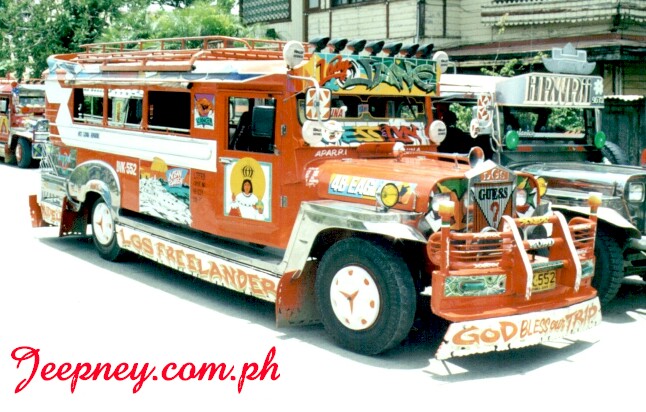
A jeepney is basically the front part of a jeep with an elongated covered back about the size of a small school bus, with two benches facing inward. The roof is very low, and you have to bend all the way over to climb in and out. The sides are open, and are too low to really see out of but let in a nice breeze and get covered with plastic when it rains. There are two metal bars that run along the roof in the back, which you can grab onto so that you don’t go careening into old ladies with shopping bags every time the driver hits a turn. The story I’ve been told is that it was born in a burst of creativity in post-War
Functionally, they are largely equivalent to the “informal” or “public” taxis that seem to operate in most of the developing world. They run on fixed routes, but without fixed stops, and will generally screech to a halt anywhere to let people on or off. Most have both a driver and a hawker/fare collector who hangs of the back yelling to people on the street and taking money from passengers. Way more people pack inside than fit comfortably, and there are often more passengers clinging to the roof or off the back. When you want to stop, you bang on the roof – if the driver doesn’t hear you, all of the other passengers will usually start yelling or banging on the roof with you. You’re almost never close enough to either the driver or the hawker, so you pass your fare up through a chain of other passengers. Your change gets passed back the same way. I’ve yet to see any fare get waylaid, either here or in
Jeepneys are significantly superior to public taxis in
Most importantly, jeepneys look cool. I’ve been told that this just means that jeepney drivers are spending their money on paint and lights and sound systems rather than on vehicle maintenance and safety. Whatever. They have names, like Bertha and John Joe and
Jeepney drivers navigate like maniacs, even by the standards of Philippine driving. First, put this in the context of a total lack of traffic rules – we’ll leave details on that for another post. Then, remember that a jeepney is the size of a small school bus and that the drivers have spent all of their money on iridescent paint rather than new brakes. Add to that the fact that half of the vehicles on the road are jeepneys, and the other half are tiny tricycles or motorella – in other words, half of the obstacles in the road weigh as much as you, and the other half are too small to see in your mirrors. Jeepneys often pull out three abreast into oncoming traffic efforts to pass one another. They maintain full speed going into intersections with no traffic light and play chicken with the cross-traffic, slamming on the brakes at the last possible second if the jeepney coming the other way has a ballsy-er driver. They swing around pedestrians and parked vehicles out into traffic with about 2 inch margins of error. Meanwhile the hawker is continuously jumping on and off the back of the moving jeepney trying to sweep up new passengers.
I’ve basically just stopped worrying about all of this and started to enjoy the ride; if I tried to judge the likelihood of death at any given second by my American driving standards, I’d be constantly seeing my life flashing before my eyes. They clearly do this all day, every day, and my likelihood of dying is pretty low. The same cannot be said for pedestrians or motorella drivers. But once you’re inside the jeepney, I figure you’re probably doing pretty well.
There are a few things I still haven’t figured out about jeepneys. One is how to get somewhere I haven’t been before. If I’m going to a major landmark, it’s pretty easy: if I want to go to Limketkai Mall, or Cogon Market, I get on a jeepney that says “R2: Liceo*Carmen*Cogon Mkt*Limketkai” on the side. But if I want to get somewhere else in town, I have to guess which jeepney will drive through that area on the way to Limketkai. This is further complicated by my observation that not all R2 jeepneys seem to take exactly the same route between the major landmarks. If I need to take multiple jeepneys to get somewhere, it’s even worse, because I have to figure out how to get off at a place where the jeepney I need to catch next is likely to drive by.
For instance, feeling very chuffed about my success in taking jeepneys to the mall, I decided to try to use them to get back from the hospital last week. First, I waited outside the hospital for 15 minutes, hoping to see a jeepney that said it was going to Carmen. This strategy failed. Next, I decided to get on a jeepney that said it was going to
There are also a few points of jeepney passenger etiquette that are still beyond me. For instance, if I’m getting off at an unusual or inconvenient stopping place, I try to get off quickly to minimize inconvenience to everyone else. When you’re at the opposite end of a long jeepney, this frequently means getting up before the jeepney has come to a complete halt and moving toward the door. The last few times I’ve attempted this, however, a young woman has bodily grabbed me and yanked me back onto the seat, saying “wait wait wait” in a very distressed tone. Three seconds later when the jeepney has come to a full and complete stop, I’m allowed to get off. Since Filipinos jump on the back of moving jeepneys with relative impunity, I can only assume that a) getting off a jeepney is very different from getting on, or b) there’s hell to pay when a white girl gets smooshed. Your guess is as good as mine.
A room of one's own
I have a housing dilemma. I’ve been staying in a “ladies dormitory” (which appears to be populated at least in half by men) that is kitty corner from one of the larger wet markets in Cagayan and 4-5 blocks from the bank where I work. The grand strategy has been, all along, to use this for a month as a base of operations from which to find a more permanent “bachelor pad” for the year. My month is up on Tuesday.
Over the course of a couple of weekends, I’ve scouted out the neighborhood behind the bank (Carmen) and a nearby middle class gated neighborhood (RER Subdivision) looking for a pad. Since most pads are rented by private owners who have a spare room or building, this has involved wandering the streets looking for “pad for rent” signs or knocking on the doors of houses that look promising. While entertaining in some ways (How to choose – the apartment building with cows grazing in the front yard, or the lechon dealer’s building with squealing piglets penned under the stairs?) this strategy has failed thus far to yield a place for me to live.
Perhaps my criteria are too demanding? They are:
- A room with a private sink and toilet
- Aircon OR screens over the windows
- Internet access
- A building that looks clean/new/unfallingapart enough that I’m convinced I won’t die from rodent attack or a mutant tropical fungus infection on the first night
Internet access may sound excessive, but given the density of hole-in-the-wall internet cafes in this town, my guess is that it’s not. Plus, I’m willing to pay extra for it. Plus, how else will I update the blog?
The closest hits I’ve had so far are two pads which were PhP 6,500 and 7,000 per month, respectively, for a room/AC/internet combo. One is in the lechon dealer’s building where my American co-worker Mark lives, practically across the street from the bank. The other is in Mrs. dela Cruz’ (a retired teacher who now sells Malaysian food products in her neighborhood Mary Kay style) home in the RER Subdivision. Unfortunately, neither is currently available.
In contemplating this state of affairs, something occurred to me. The dorm I’m living in now is PhP 8,000 per month. That includes internet, unlimited AC, a communal kitchen with a stove and refrigerator and rice cooker, a hot water shower (not included at the other places), a flat screen TV with cable, nice young women who talk to me and in theory clean my room, and nice young men who guard the entrance 24-7 and glower at the clowns outside who try to talk to me. It looks shiny new on the inside (ants not withstanding), and has much nicer bathrooms than anything I’ve seen anywhere else. It’s within walking distance of the bank, and is across the street from a large grocery store and wet market where it’s easy to buy stuff and catch jeepneys at all times of the day.
Assuming I could get one of the other pads now, which I can’t, I think that the best I’d do would be PhP 6,500 per month – more if I use the AC a lot – plus several thousand pesos in start-up costs to buy a stove top, fridge, rice cooker, and hot water heater.
I see a few options now:
- Take a substandard pad for a month for a lot less money (PhP 3,500 – 4,000) and keep looking for a nicer place. Resign myself to a hot room, cold showers, and no internet for a month.
- Pay for another month at the dorm and keep looking or hope that one of the other places I’ve found becomes vacant. Most places are full with local university students right now – I’m not sure if that situation will change or not.
- Arrange to stay at the dorm long term, and see if they’re willing to lower the rent at all if I commit to a whole 6 months or year.
Thoughts? Keep in mind that we’re talking about a 25% price difference here. And that 25% of my monthly rental is equal to about $30.
Tuesday, August 12, 2008
Stranger in a strange land
UPDATE and DISCLAIMER: Okay, so I may have hijacked/misrepresented Matt's subtle point to make a more obvious one, below. But I needed a literary interlocutor, and he was the cutest one I could find.
As promised, this is an introductory post on the first of my three blogging themes: life as an outsider in the
And yes – since you ask – I did have a lot of time on my hands this weekend (even after watching extended versions of all three LoTR movies!). No, I will not usually be able to maintain this sort of posting prolificacy. Everyone can breathe a sigh of relief.
What I’m doing
A very brief introduction to where I am and what I’m doing, in case you don’t know. I’m living in Cagayan de Oro City, in northern
I recently started working for Innovations for Poverty Action which is a group of academic economists who are trying to figure out which of the many ‘development’ programs in the
Introduction to theme, as promised
A VIP recently made some astute comments (as usual) about life as a foreigner. It’s possible that he may have been just a tiny bit biased in favor of his hidden agenda to convince me that I didn’t really want to move thousands of miles away from everyone I know and love. Nonetheless, I take these as my starting point. Hopefully he won’t kill me for casting him in the Eeyore role.
First, and more obviously, you start out ignorant of the language, traditions, cultural practices and taboos of your adopted country. This is not just a barrier to making bosom friends right away – it’s a big glass wall between you and any sort of authentic or confident interaction with co-workers, potential friends, taxi drivers, people who sell you mangoes, and everyone else. Consequently, you are a) more alone than you would ever be in your home country, because even superficial interactions are awkward and unnatural; and b) in an energy-draining constant state of embarrassment and self-doubt, because you know that you’re making a fool of yourself in every possible way.
The alone-ness actually doesn’t bother me much. As a rule, I enjoy being on my own and free from social obligations for extended periods of time. The awkwardness is more of an issue, hyper-sensitive as I am to maintaining the illusion of dignity. (Who, me? Trip over my tail? I can’t imagine what you’re talking about.) This combination of personal predilections actually leads to the worst sort of trap for a stranger in a strange land: I don’t mind being alone and am easily embarrassed, so the risks involved with meeting new people almost always appear to outweigh the opportunity cost of keeping to myself. In this mind-set, I am highly likely to miss out on all of the best parts of living abroad.
Sure, but suppose you live somewhere for a couple of years. You learn enough of the language to get by, and you start to pick up on social cues. You make a few friends. Then you’re okay, right?
But Matt pointed out what I always forget: what you do and why isn’t enough; it also matters how other people perceive you. And you can’t determine how people on the street perceive you just by adopting local patterns of behavior. People’s perceptions and actions are deeply influenced by things that you can’t control: accent, skin color, gender, and so on. The fact that my poor little liberal-rationalist heart tells me that this shouldn’t happen (life is so unfair!) doesn’t make it untrue.
Demotivational posters in honor of Matt.
Subscribe to:
Posts (Atom)